


Traditional Pink Cotton Hazarbuti Saree featuring Exclusive Geometric Pallu | Odisha Handloom Saree
Guarantee Safe Checkout
Traditional Pink Cotton Hazarbuti Saree featuring Exclusive Geometric Pallu | Odisha Handloom Saree
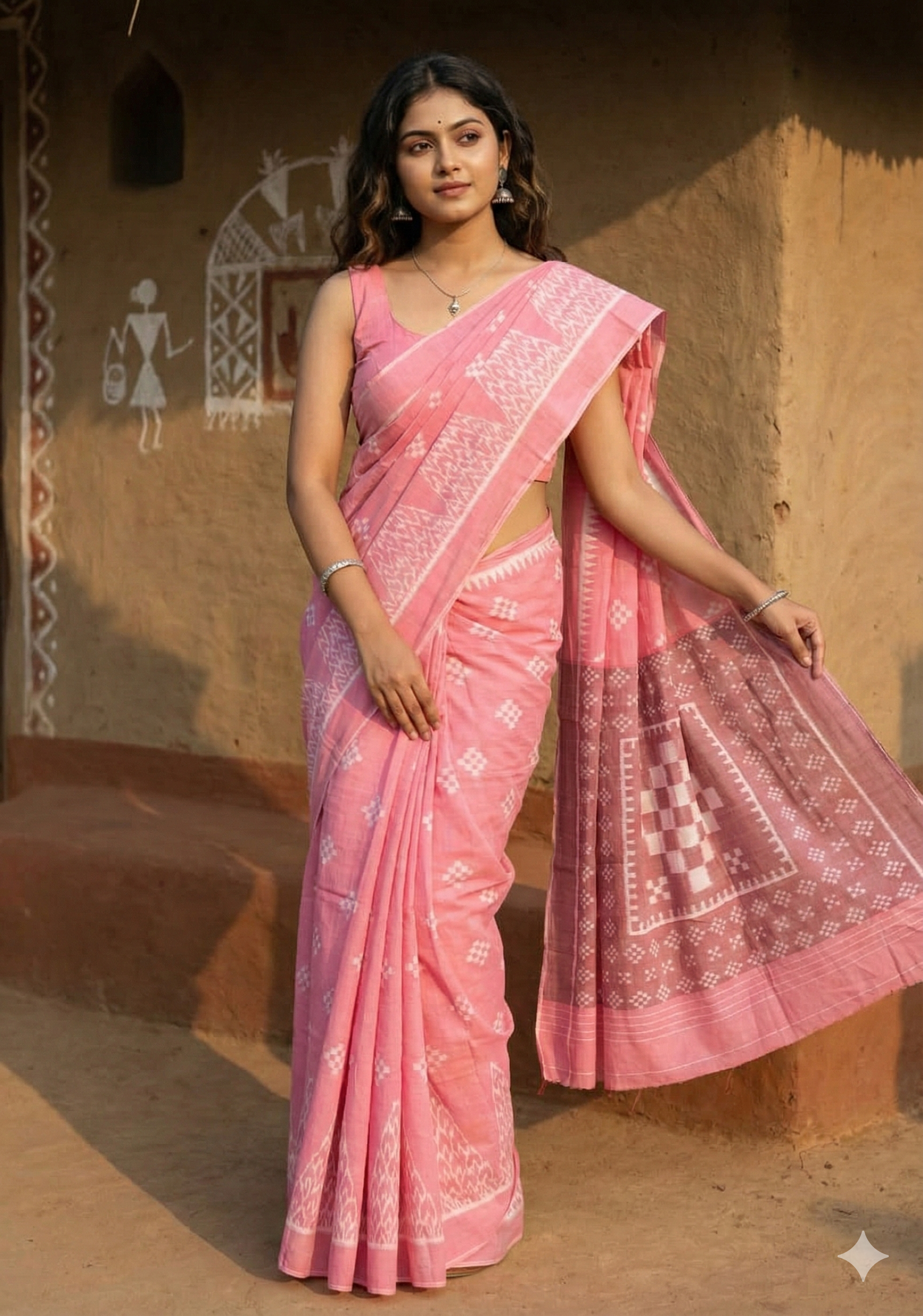
Body The main body of the saree is a soft pink color. It is adorned with a "hazarbuti" pattern, which consists of numerous small, white, diamond-shaped motifs (butis) arranged in a neat, repeating diagonal grid across the entire fabric.
Border The saree has a distinct border running along its length. The design features a classic white "temple" or sawtooth pattern, which is framed by several thin, parallel white lines.
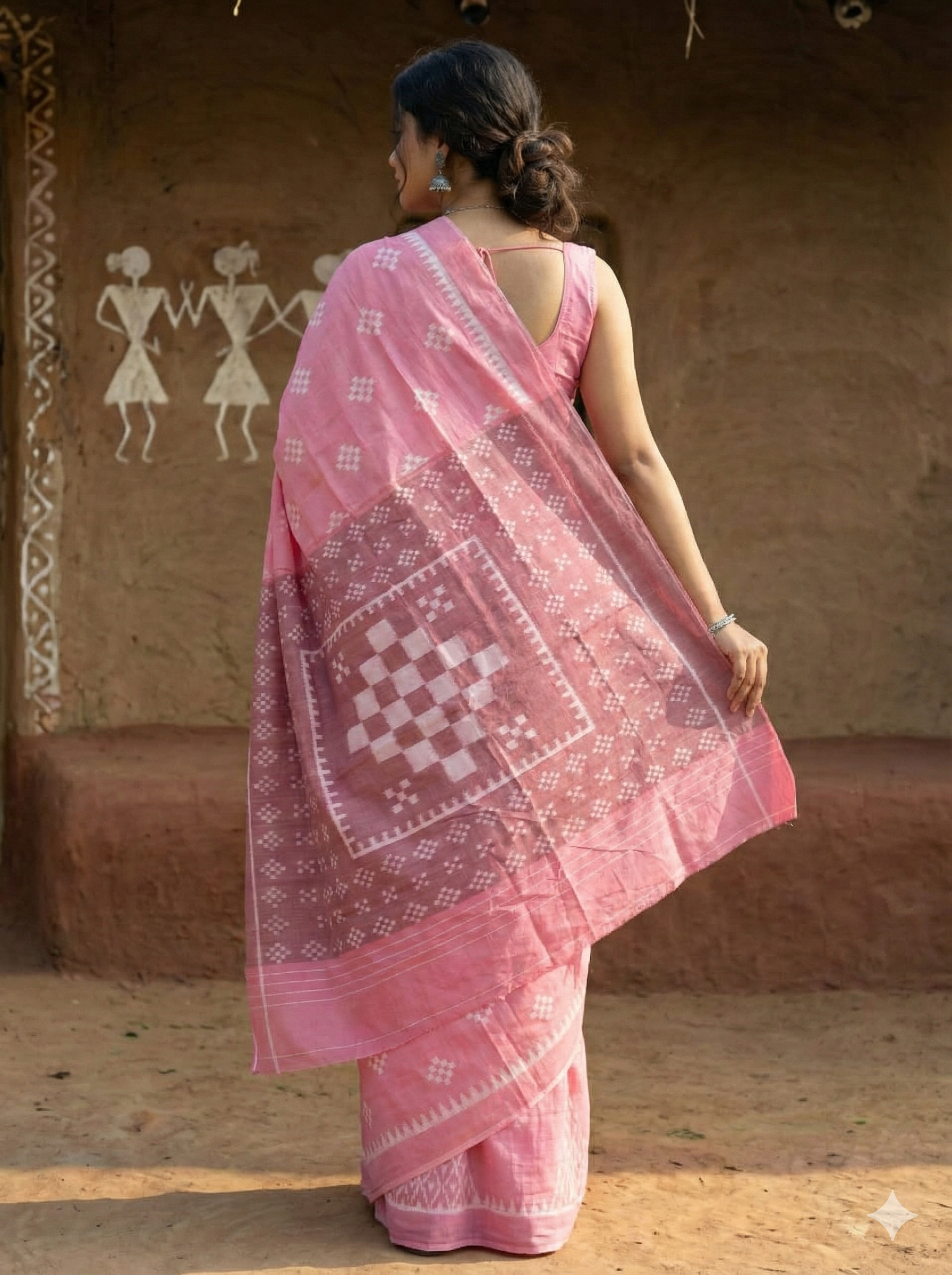
Pallu (Anchal) The pallu is the most prominent and "exclusive" part of the saree, showing a clear shift in design and color. The background color transitions to a darker, dusty rose or mauve shade.
-
Central Motif: The centerpiece of the pallu is a large square containing a bold, graphic white checkerboard or grid pattern.
-
Surrounding Patterns: This central square is framed by multiple borders. One border is made of densely packed small white diamonds, similar to the body motif. There are also additional horizontal bands filled with small, repeating diamond geometric patterns above and below the main square. The very end of the pallu (blouse piece section) is characterized by simple, thin vertical white stripes.
Specifications
- Saree Color: Deep Blue
- Fabric: Pure Mercerised Cotton
- Wash Care: Dry Clean
- Brand: SUTA-SAGA
- Product category: Bomkai cotton
- Length: 6.25 Metres (including blouse)
Notes
- Model's blouse is for display only; a running blouse piece is included. For a bold look, try pairing this saree with a contrast blouse.
- Slight color variations are to be expected and are a characteristic feature of authentic, hand-dyed textiles.
- Please embrace the slight irregularities of this handwoven drape, as the true beauty of handloom lies in its unique imperfections.
- Digital Representation: We use AI technology to showcase the styling potential of this saree. The fabric and details are 100% true to the actual product.
----------------------------------------------------------------------------------
The Hazarbutti design is a hallmark of Odisha Ikat (also known as Bandha) craftsmanship, where skilled weavers create thousands of tiny motifs across the saree's body
The term Hazarbutti (also spelled Hazar Buti, Hazarbooti) originates from Hindi.
-
"Hazar" means a thousand.
-
"Buti" refers to a small motif, floral design, or boota.
Therefore, a Hazarbutti design literally means a pattern featuring "a thousand small motifs."
Key Characteristics of a Hazarbutti Saree:
-
Densely Packed Motifs: The defining feature is that the entire body of the saree is covered with a vast number of tiny, repeating motifs. These can be geometric shapes (like diamonds, as seen in your image), floral patterns, or small figures like fish or turtles.
-
Intricate Craftsmanship: Creating these thousands of tiny motifs requires meticulous skill and takes a significant amount of time, often weeks or months for a single saree. This makes each piece a unique work of art.
-
Weaving Techniques: The motifs are typically created using complex handloom weaving techniques like Ikat (where yarns are dyed before weaving to create the pattern) or the extra-weft technique (where additional threads are inserted to create raised motifs).
-
Origin: These sarees are a traditional and celebrated form of handloom from the state of Odisha, India, specifically from regions like Sambalpur, Bargarh, Sonepur, and Nuapatna.
-
Fabric: While often seen in silk (Tussar, Mulberry), the design is also applied to cotton sarees, as in the example you provided.
-
Contrasting Elements: The body with its thousand motifs is often paired with a bold, contrasting border (frequently featuring traditional "temple" or sawtooth designs) and an elaborate, distinct pallu (anchal).
