
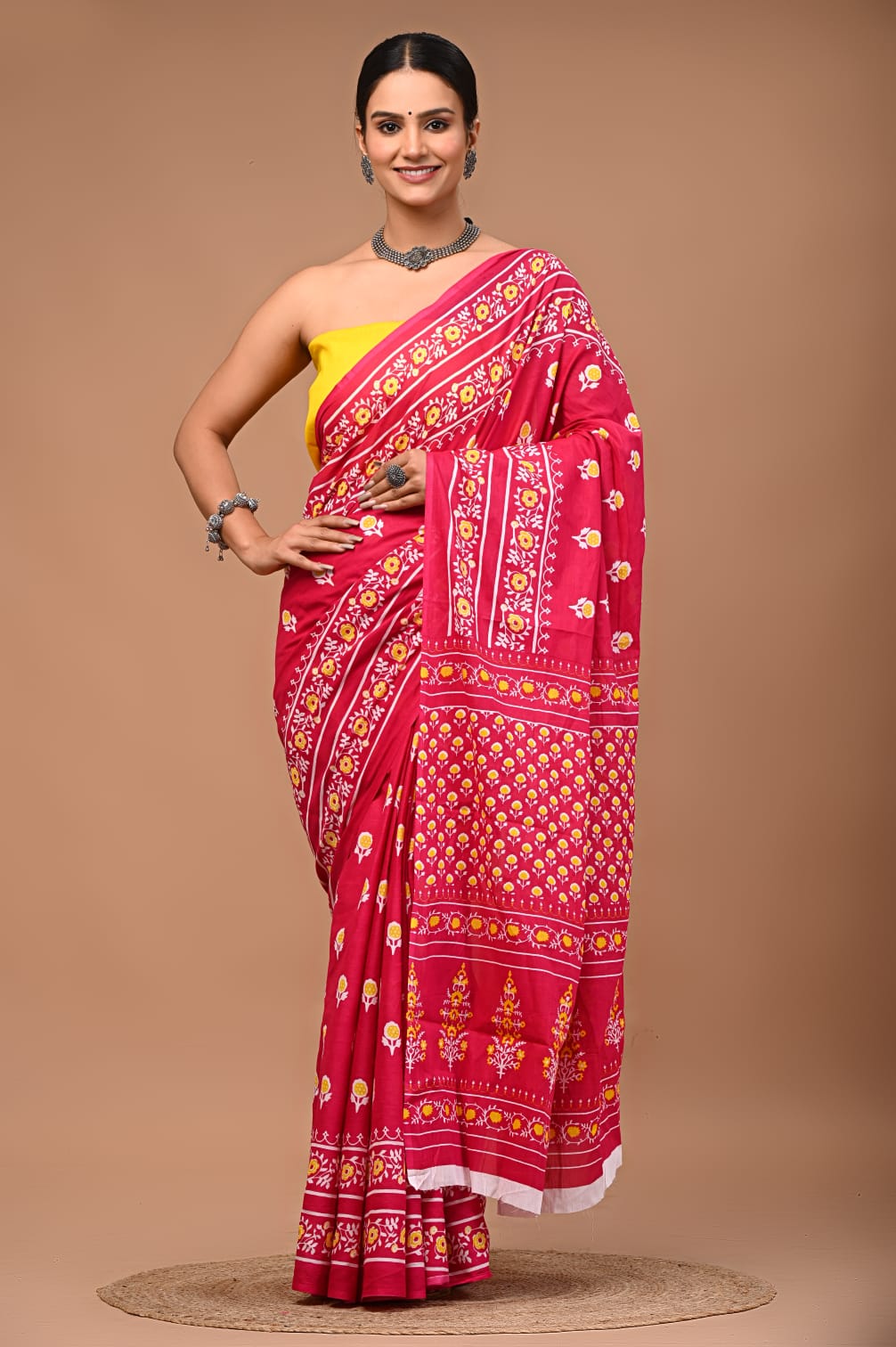
Pink Paradise – Floral Block Print Mul Cotton Saree
Guarantee Safe Checkout
Pink Paradise – Floral Block Print Mul Cotton Saree
Step into the spotlight with this radiant Rani Pink (Magenta) Saree. Woven from the softest Mul Mul (Muslin) Cotton, this drape offers the perfect blend of traditional charm and modern comfort.
The saree is adorned with delicate floral vines and geometric borders in contrasting bright yellow and crisp white. The vertical floral stripes on the upper body elongate your silhouette, while the horizontal bands on the pleats add a rhythmic, heritage touch. It’s vibrant, joyful, and designed for the woman who loves to wear her happiness.
Why you’ll love it:
- Mood-Lifting Color: The striking combination of Rani Pink and Sunshine Yellow is an instant energy booster.
- Breezy Comfort: The ultra-light Mul cotton fabric keeps you cool and comfortable all day.
- Heritage Charm: The intricate floral motifs pay homage to traditional Rajasthani block printing.
Key Features:
- Fabric: 100% Pure Mul Cotton (Soft, sheer, and lightweight).
- Color Palette: Deep Rani Pink (Fuchsia) with Yellow and White patterns
- Technique: Hand Tie-Dye / Shibori.
- Dye Type: 100% Natural Vegetable Dyes (Skin-friendly).
- Brand: SUTA-SAGA
- Pattern: Vertical floral vine stripes on the shoulder/pallu and horizontal geometric floral borders on the pleats.
- Length: 6.5 meters (with blouse)
Wash Care:
- Since this product uses natural dyes, color bleeding may occur in the first few washes.
- Hand wash separately in cold water with mild detergent or salt water to fix the colors.
- Dry in shade to prevent fading.
Notes
- Model's blouse is for display only; a running blouse piece is included. For a bold look, try pairing this saree with a contrast blouse.
- Slight color variations are to be expected and are a characteristic feature of authentic, hand-dyed textiles.
- Please embrace the slight irregularities of this handwoven drape, as the true beauty of handloom lies in its unique imperfections.
- Digital Representation: We use AI technology to showcase the styling potential of this saree. The fabric and details are 100% true to the actual product.
----------------------------------------------------------------------------------------------------------------------------
Bagru hand block printing is a centuries-old textile art form originating from the town of Bagru in Rajasthan, India. Known for its use of natural vegetable dyes and earthy tones, this craft has been preserved for over 400 years by the local artisan community.
Here is a detailed description of its history, origins, and techniques:
1. Origins and the Chhipa Community
- The Makers: The history of Bagru print is intrinsically linked to the Chhipa community (derived from the word chhaapna, meaning "to print"). These artisans migrated to Bagru from regions like Sawai Madhopur, Alwar, or Gujarat roughly 400–450 years ago.
- Why Bagru? The community settled near the Sanjaria river. Its clay-rich soil and water were essential for the specific washing, dyeing, and mud-resist techniques that define Bagru printing.
- Patronage: Historically, Bagru prints were not made for royalty but for local peasants, pastoral communities, and Rajputs. The specific motifs and colors worn often signaled the wearer’s marital status and social standing.
2. Distinctive Techniques
Bagru printing is famous for its labor-intensive process that relies entirely on natural materials.
- Harda Treatment: Before printing, the fabric is soaked in a solution of Harda (myrobalan fruit) and water. This turns the cloth yellow and acts as a mordant (fixative), allowing the natural dyes to bind permanently to the fibers.
- Dabu (Mud Resist) Printing: A signature technique of Bagru is Dabu. Artisans apply a thick paste made of clay, lime, gum, and wheat chaff onto the fabric using wooden blocks. This paste "resists" dye, meaning the areas covered in mud remain undyed when the fabric is dipped in color (usually Indigo), creating a striking contrast.
- Carving: Intricate designs are hand-carved into seasoned Sheesham wood blocks. A single pattern often requires a set of three blocks: the rekh (outline), gadh (background), and datta (filler).
3. The Palette: "Syahi-Begar" and Natural Dyes
Unlike modern chemical prints, authentic Bagru history is defined by its strict use of nature-derived colors:
- Syahi (Black): A deep black color created by fermenting iron filings (often from old horseshoes) with jaggery and gum.
- Begar (Red): A rich red hue achieved using madder root (alizarin) and alum.
- Indigo (Blue): Derived from the indigo plant, used for the characteristic deep blue backgrounds found in Dabu prints.
- Other Earth Tones: Yellows are derived from turmeric or pomegranate rinds, while greens are created by mixing indigo and turmeric.
4. Motifs and Identity
- Nature-Inspired: The designs traditionally draw from nature, featuring floral motifs (buttis) like the marigold, rose, and lotus, as well as coriander leaves and chili shapes.
- Geometric: Over time, Persian influence introduced geometric patterns such as jaali (grids), chaupad (checks), and leheriya (waves).
- Visual Distinction: A key historical difference between Bagru and the nearby Sanganeri print is the background. While Sanganeri prints traditionally feature colorful designs on a white background, Bagru prints are known for their dark or dyed backgrounds (typically indigo or mud-brown).
